

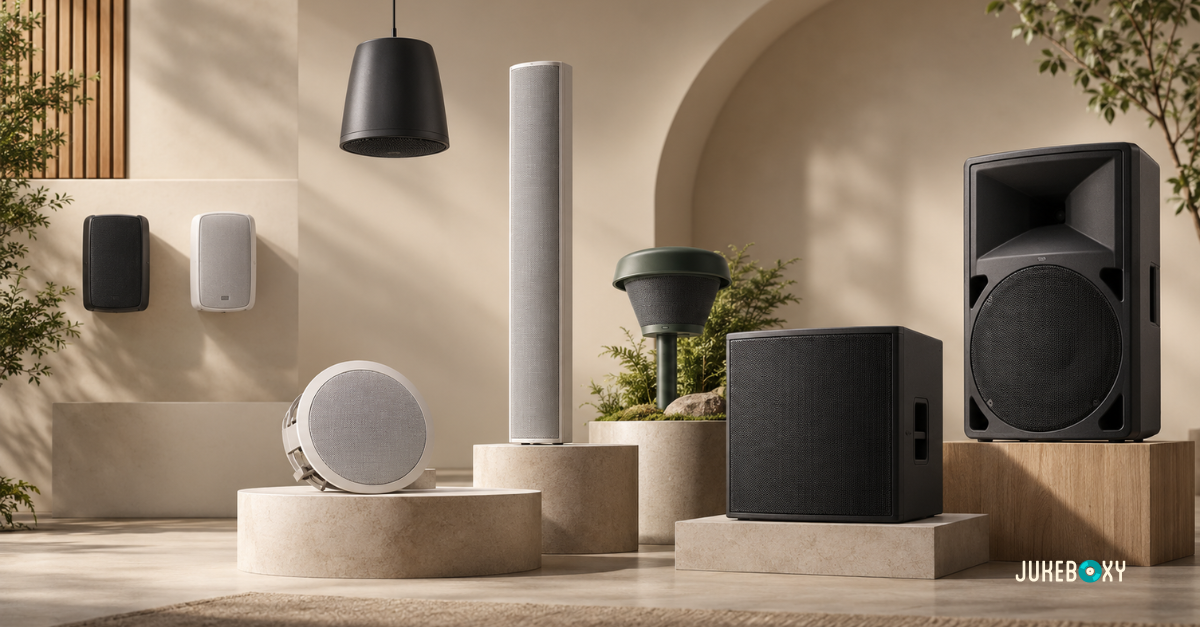
Choosing the best sound system for a restaurant, bar, coffee shop, or retail store depends primarily on the size of the space, the number of audio zones, and how the speakers will be installed.
For small businesses under roughly 1,500 square feet, two to four powered or wireless speakers may be enough. Mid-size restaurants and stores often benefit from a Sonos Amp paired with passive wall or ceiling speakers, while larger or multi-zone businesses typically need a professionally installed commercial audio system.
This 2026 guide compares sound system options by business type, budget, and space size. It also explains speaker placement, 70V vs. low-impedance systems, Sonos options, and what businesses need to consider when playing background music legally.
Jukeboxy has provided licensed background music for businesses since 2013 and works with restaurants, retailers, bars, cafés, and other commercial locations throughout the United States and Canada.
Best Sound Systems for Restaurants and Stores: 2026 Comparison
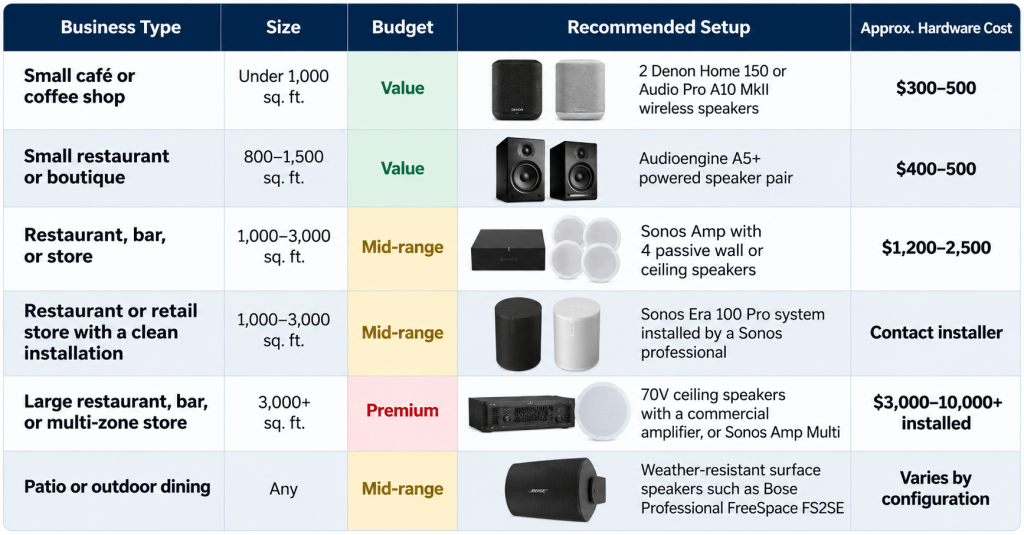
Use this table as a starting point when choosing a commercial sound system. Hardware prices change frequently and installation costs vary by location.
Quick summary of the comparison
- Small café or coffee shop (under 1,000 sq. ft.): two Denon Home 150 or Audio Pro A10 MkII wireless speakers, about $300 to $500.
- Small restaurant or boutique (800 to 1,500 sq. ft.): an Audioengine A5+ powered speaker pair, about $400 to $500.
- Restaurant, bar, or store (1,000 to 3,000 sq. ft.): a Sonos Amp with four passive wall or ceiling speakers, about $1,200 to $2,500.
- Restaurant or store that wants a clean, built-in look (1,000 to 3,000 sq. ft.): a Sonos Era 100 Pro system installed by a Sonos professional. Pricing comes from the installer.
- Large restaurant, bar, or multi-zone store (3,000+ sq. ft.): 70V ceiling speakers with a commercial amplifier, or Sonos Amp Multi, about $3,000 to $10,000+ installed.
- Patio or outdoor dining: weather-resistant speakers such as the Bose Professional FreeSpace FS2SE. Cost varies by setup.
Jukeboxy can work with these setups through the Jukeboxy Player Box, supported mobile devices, or compatible Sonos systems.
How We Chose These Sound Systems
A commercial audio system should do more than sound good.
For restaurants and retail businesses, the most important factors include:
- Even sound coverage
- Installation complexity
- Reliability during long operating hours
- Ability to expand as the business grows
- Multi-zone control
- Connectivity options
- Compatibility with commercial background music services
- Cost relative to the size of the space
A system that works well in a 700-square-foot coffee shop may be completely unsuitable for a 5,000-square-foot restaurant. For that reason, our recommendations are organized primarily by business size and use case.
Recommended Sound Systems by Business Type
Recommended Speakers for Coffee Shops and Cafés
Coffee shops generally need clear background music at relatively low volume. The goal is to create atmosphere without interfering with conversation.
For smaller cafés, wireless speakers are often the easiest option because they require minimal installation.
Denon Home 150
The Denon Home 150 is a compact wireless speaker with Wi-Fi, Bluetooth, and a 3.5 mm auxiliary input.
Using two or more speakers throughout a small café can create more balanced coverage than using a single louder speaker.
Audio Pro A10 MkII
The Audio Pro A10 MkII is another compact option suitable for cafés and smaller commercial spaces. Multiple speakers can be distributed throughout the room to create more consistent background sound.
Both systems can work with Jukeboxy using compatible audio connections or playback devices.
For playlist recommendations, see our guide to music for coffee shops.
Recommended Sound System for Small Restaurants
For smaller dining rooms, powered speakers can provide strong sound quality without requiring a separate amplifier.
One option is the Audioengine A5+.
Audioengine A5+ Wireless
The A5+ Wireless includes Bluetooth and analog audio inputs, making it relatively easy to connect to a commercial music player.
Audioengine A5+ Classic
The wired version includes analog inputs and can work well with a dedicated business music player such as the Jukeboxy Player Box.
Powered speakers are especially practical for restaurants that want good audio quality without installing ceiling speakers throughout the room.
Recommended Sound System for Bars
Bars typically operate at higher ambient noise levels than restaurants or cafés, so speakers need to remain clear at higher volumes.
A strong mid-range configuration is a Sonos Amp connected to passive wall or ceiling speakers.
The Sonos Amp provides 125 watts per channel at 8 ohms and can power multiple compatible passive speakers while allowing staff to control playback and volume through the Sonos ecosystem.
For larger bars, separate audio zones are usually preferable.
For example:
- Main bar area
- Dining area
- Patio
- Private room
- Game room
Separate zones allow each area to operate at an appropriate volume without changing the entire system.
See our complete guide to bar music for more information about building the right atmosphere throughout the day.
Recommended Speakers for Retail Stores
Retail stores usually benefit from even sound distribution across the entire floor.
Customers should hear approximately the same volume near the entrance, checkout area, fitting rooms, and back of the sales floor.
For that reason, ceiling or professionally mounted speakers often work better than placing a few loud speakers around the store.
Small and Mid-Size Stores
Sonos Era 100 Pro speakers are designed for professional installations and support Power over Ethernet, Wi-Fi 6, and flexible mounting.
Era 100 Pro systems are available through professional Sonos installers rather than through the standard consumer retail channel.
Larger Retail Stores
Larger stores may benefit from commercial 70V ceiling speaker systems using products from manufacturers such as JBL Professional or Bose Professional.
These systems make it easier to distribute many speakers over larger areas.
Learn more about choosing music for retail stores.
Recommended Outdoor Speakers for Restaurant Patios
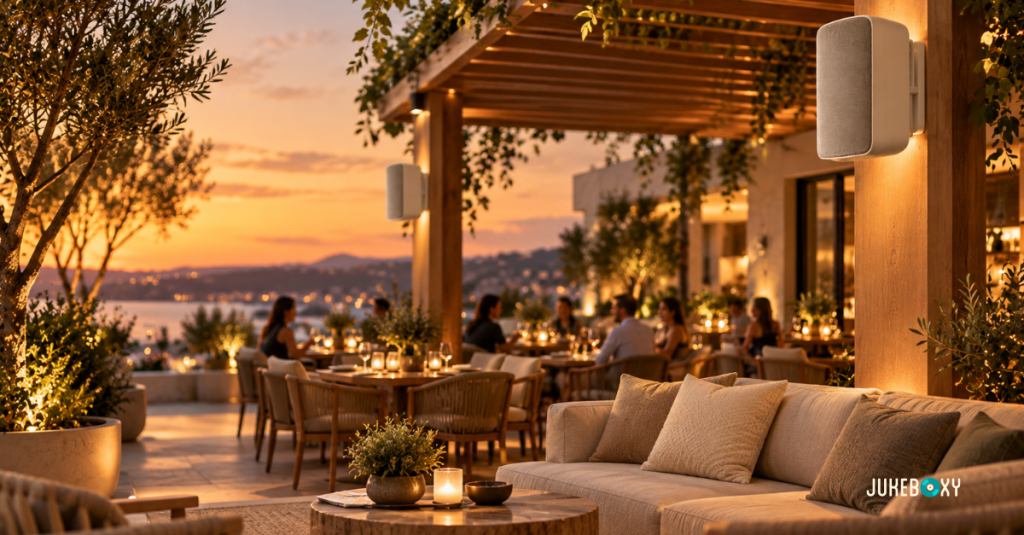
Outdoor dining areas require speakers specifically designed to handle exposure to weather and temperature changes.
Surface-mounted commercial speakers such as the Bose Professional FreeSpace FS2SE are one option for patios and outdoor dining spaces.
Whenever possible, the outdoor area should have its own audio zone.
This allows staff to lower the patio volume in the evening without changing the music level inside the restaurant.
Sonos for Business Sound Systems
Sonos has become a common choice for restaurants and retail businesses because the system combines relatively simple control with a clean installation.
Depending on the size of the business, several Sonos products may be appropriate.
Sonos Era 100 Pro
Era 100 Pro is designed specifically for professional installations.
Features include:
- Power over Ethernet
- Wi-Fi 6
- Professional mounting options
- Flexible speaker positioning
- Integration with professional Sonos installations
Pricing is provided through authorized Sonos installers.
Sonos Amp
Sonos Amp connects traditional passive speakers to the Sonos ecosystem.
It provides 125 watts per channel at 8 ohms and can be used with wall-mounted or ceiling speakers.
For many restaurants and smaller retail stores, this provides a balance between professional speaker coverage and simple digital control.
Sonos Amp Multi
Introduced for professional installations in 2026, Sonos Amp Multi is designed for larger and more complex commercial audio systems.
It provides eight amplified outputs and supports up to four independent audio zones.
For restaurants with separate dining rooms, bars, patios, or private areas, this can simplify multi-zone audio management.
Sonos Pro
Sonos Pro provides centralized management tools designed for businesses operating Sonos systems.
Businesses should also consider music licensing separately from the speaker hardware itself.
Owning Sonos equipment alone does not automatically grant permission to use personal music streaming subscriptions commercially.
Businesses should use a music source that is licensed for commercial playback.
Jukeboxy integrates with compatible Sonos systems and provides licensed background music, playlist scheduling, remote management, and multi-location controls for businesses.
70V vs. 8-Ohm Speakers: Which Does Your Business Need?
Most small businesses do not automatically need a 70V audio system.
Traditional low-impedance systems, commonly referred to as 8-ohm systems, can work well when a business uses a relatively small number of speakers over shorter cable distances.
A 70V commercial audio system becomes more useful when the business has:
- Many speakers
- Long cable runs
- Large floor areas
- Multiple audio zones
- Complex commercial installations
When to Choose an 8-Ohm System
An 8-ohm system may be appropriate for:
- Small restaurants
- Cafés
- Small boutiques
- Smaller bars
- Businesses using roughly four to eight speakers
These systems are generally simpler and less expensive.
When to Choose a 70V System
Consider a 70V system when you need:
- More than approximately eight speakers
- Long speaker wire runs
- Large dining or retail areas
- Multiple zones
- Greater control over individual speaker levels
70V systems are commonly used in commercial ceiling-speaker installations and are generally best designed by a professional audio installer.
How Many Speakers Does a Restaurant or Store Need?
Speaker requirements depend on room layout, ceiling height, speaker dispersion, background noise, and the desired listening level.
As a general starting point for ceiling speakers, businesses can estimate approximately one speaker for every 150 to 250 square feet with standard 9- to 10-foot ceilings.
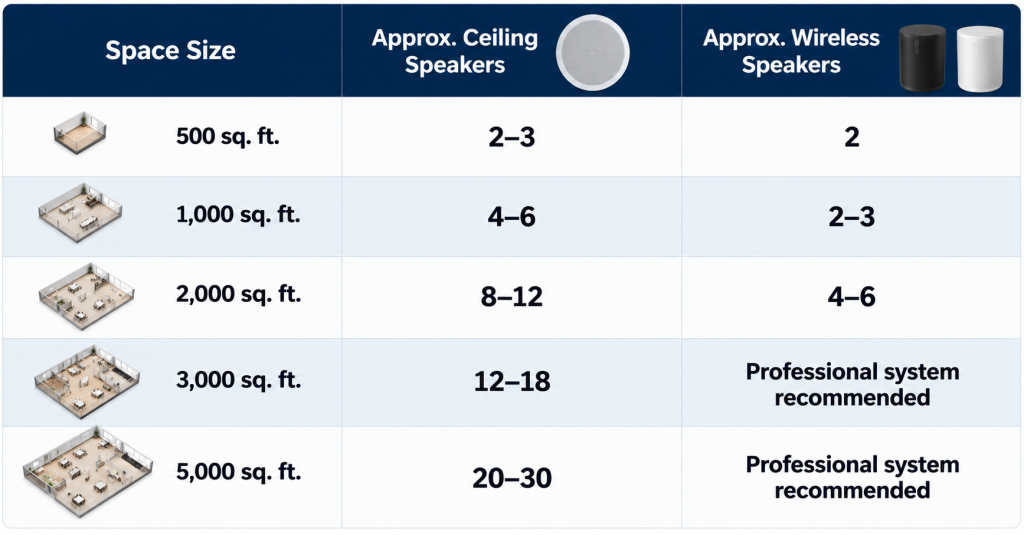
These numbers should be treated as planning estimates rather than strict installation rules.
Ceiling height, room shape, furniture, wall materials, and ambient noise can significantly change the number of speakers required.
In most businesses, more speakers playing at a moderate volume provide better coverage than a small number of speakers operating loudly.
How Much Does a Restaurant Sound System Cost?
Commercial sound systems vary widely in cost.
A small café may spend a few hundred dollars, while a large multi-zone restaurant can spend several thousand dollars on equipment and professional installation.
Installation costs depend heavily on:
- Ceiling construction
- Existing wiring
- Number of speakers
- Number of zones
- Building access
- Local labor costs
Businesses planning ceiling-speaker installations should consider getting quotes from multiple commercial audio installers.
For nationwide sound system design and installation consultation, we recommend OnSite Media, Jukeboxy’s solution partner for A/V design and installation services.
Wired vs. Wireless Sound Systems for Restaurants
Both wired and wireless systems can work well in commercial environments.
The better choice depends on the size and design of the business.
Wireless Systems
Wireless systems work well when:
- The space is relatively small
- Installation needs to be fast
- Running speaker wire is difficult
- The business may change layouts
- Only a few speakers are required
Wireless speakers are particularly practical for cafés, boutiques, and smaller restaurants.
Wired Systems
Wired systems are usually better when:
- The space is large
- Many speakers are required
- Consistent audio coverage is important
- The speakers need to remain visually discreet
- Multiple zones are required
- The business wants a permanent installation
Many restaurants use a combination of both.
For example, a restaurant might use wired ceiling speakers in the dining area and separate outdoor speakers for the patio.
Commercial Music Licensing: The Step Businesses Should Not Ignore
Choosing speakers is only part of building a commercial sound system.
Businesses also need to make sure the music they play is authorized for commercial use.
Personal music streaming accounts are generally intended for personal rather than commercial playback.
For example, Spotify, Apple Music or YouTube Music state that their consumer service cannot be publicly played in businesses such as restaurants, bars, and retail stores.
➡️ Spotify and Business Use: Licensing Limitations Explained
In the United States, public performance rights are administered by performing rights organizations including:
- ASCAP
- BMI
- SESAC
- GMR
Other rights may also apply depending on the type of music use such as live music, Karaoke, and similar.
In Canada, organizations including SOCAN and Re:Sound administer applicable music rights.
Copyright violations can expose businesses to significant liability. Under U.S. copyright law, statutory damages generally range from $750 to $30,000 per infringed work and may reach $150,000 when infringement is found to be willful.
Jukeboxy provides commercially licensed background music for businesses. Its licensing arrangements cover applicable music rights through organizations including ASCAP, BMI, SESAC, GMR, and SoundExchange in the United States, as well as SOCAN and Re:Sound in Canada, subject to Jukeboxy’s terms and permitted business uses.
Businesses should always confirm that their specific music use is covered by their service and licenses.
Frequently Asked Questions
What is the best sound system for a small restaurant under $1,000?
For a small restaurant, a pair of quality powered speakers such as the Audioengine A5+ or several compact wireless speakers can provide good coverage without requiring a professional installer. The right choice depends on the room layout and size. In many spaces under approximately 1,500 square feet, two to four properly positioned speakers may be sufficient for background music.
What speakers should a coffee shop use for background music?
Small coffee shops generally benefit from compact wireless or powered speakers distributed throughout the seating area. Options such as the Denon Home 150 or Audio Pro A10 MkII can work well for smaller spaces. The goal should be consistent coverage at moderate volume rather than placing one loud speaker in a single area.
Do I need a 70V sound system for my store?
Not necessarily. Smaller stores with only a few speakers can often use a traditional low-impedance system. A 70V commercial system becomes more useful when a store needs many speakers, long cable runs, multiple audio zones, or broad coverage across a large floor.
How many ceiling speakers do I need for a 2,000-square-foot store?
A rough starting estimate is approximately 8 to 12 ceiling speakers for a 2,000-square-foot space with standard ceiling heights. However, room layout, ceiling height, speaker model, background noise, and required volume should also be considered. A professional installer can calculate more precise coverage.
Can I use Sonos speakers in a restaurant or retail store?
Yes. Sonos systems can work well in restaurants, retail stores, cafés, and similar commercial spaces. Products such as Sonos Amp, Era 100 Pro, and Amp Multi provide options for different installation sizes. Businesses still need to ensure that the music source they use is properly licensed for commercial playback.
What is the easiest restaurant sound system to install without a professional?
Powered and wireless speakers are generally the easiest systems to install without professional help. They require less wiring and can often connect directly to a music player through Wi-Fi, Bluetooth, or an analog audio connection. For larger spaces or ceiling-speaker installations, professional installation is generally preferable.
How much does a restaurant sound system cost in 2026?
A basic sound system for a small restaurant may cost roughly $300 to $1,000. Mid-size systems using Sonos Amp or professionally installed speakers may cost approximately $1,200 to $5,000 or more. Large commercial systems with many speakers, multiple zones, and professional installation can exceed $10,000.
Is it legal to play Spotify in a restaurant?
A personal Spotify account is not intended for commercial public playback. Spotify specifically states that its consumer service is for personal, non-commercial use and should not be played publicly in businesses. Restaurants should use a music service specifically licensed for commercial use.
What kind of music service should a business use with Sonos?
Businesses should use a music service that permits commercial playback rather than relying on a personal consumer streaming subscription. Jukeboxy integrates with compatible Sonos systems and provides commercially licensed music, curated playlists, scheduling, remote controls, and multi-location management.
Is a wired or wireless sound system better for a restaurant?
Wireless systems are often better for small restaurants that need a fast and flexible installation. Wired systems generally work better for large spaces, businesses requiring many speakers, and permanent ceiling-speaker installations. Some restaurants combine both approaches to create separate indoor and outdoor audio zones.
Complete Your Sound System with Licensed Music for Business
Choosing the right speakers is only one part of creating a reliable restaurant or retail sound system.
Businesses also need music that is appropriate for public playback and tools that make it easy to control what customers hear throughout the day.
Jukeboxy provides licensed background music for restaurants, bars, coffee shops, retail stores, and other commercial businesses in the United States and Canada.
Features include:
- Commercially licensed music
- Professionally curated playlists
- Daypart scheduling
- In-store audio messaging
- Remote music management
- Multi-location controls
- Sonos integration
Already using Sonos? Jukeboxy can combine your compatible Sonos system with licensed business music, in-store audio messaging and centralized controls.
Start your 14-day free trial of Jukeboxy Music for Business.
