


Quick answer: Yes, businesses can play Christmas music, but they need public performance licenses. Personal streaming accounts don’t cover business use, and most popular holiday songs are still under copyright.
You want your store to feel festive in December. But one wrong playlist can turn holiday cheer into a copyright claim.
Christmas music licensing for business follows the same rules as any other music, and most owners are surprised by how few holiday songs are actually free to play. The good news: yes, your business can play Christmas music, as long as it’s licensed.
This guide covers what the law says in the US and Canada in 2026, which myths to ignore, and the easiest way to stay compliant all season.
This article is general information, not legal advice.
Why Holiday Music Needs a License
WhenWhen you play music where customers can hear it, the law treats it as a public performance. That’s true in a store, a restaurant, a hotel lobby, a gym, or a waiting room. It doesn’t matter whether the music is free to you or whether anyone is really listening.
Every song you play has two layers of rights:
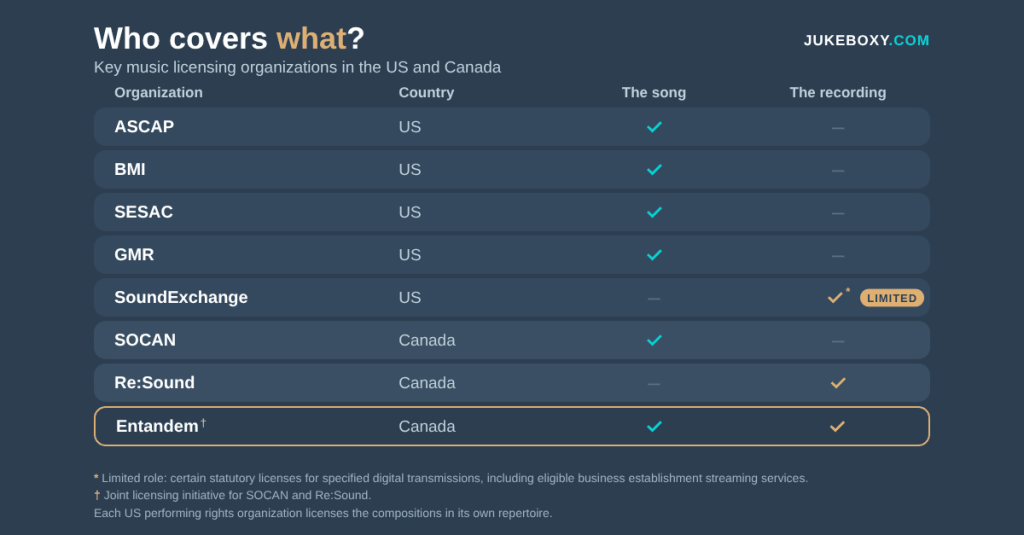
The recording. The exact recorded version you play, owned by record labels and performers. In the US, a commercial music service covers this side. In Canada, it’s licensed through Re:Sound. you play music where customers can hear it, the law treats it as a public performance. That’s true in a store, a restaurant, a hotel lobby, a gym, or a waiting room. It doesn’t matter whether the music is free to you or whether anyone is really listening.
The song (composition). The melody and lyrics, owned by songwriters and publishers. In the US, this side is licensed through ASCAP, BMI, SESAC, and GMR. In Canada, it’s licensed through SOCAN.
A personal Spotify, Apple Music, or YouTube account doesn’t give you the right to play either one for customers. Their terms limit those accounts to personal listening. This is the most common way small businesses fall out of compliance. Here is more on why personal streaming accounts fall short.
How Christmas Music Licensing for Business Works in the US and Canada
In the United States
Songwriters and publishers are represented by performing rights organizations, often called PROs. There are four main ones:
- ASCAP
- BMI
- SESAC
- GMR (Global Music Rights)
Each PRO controls a different catalog. One holiday playlist can easily include songs from all four. If you license only one, the rest of your playlist is still unlicensed. Our complete guide to business music licensing explains how each PRO works.
The recording side is usually handled by your music source. A commercial music service clears its recordings for business use. A personal app does not, which is one more reason it won’t work in your store.
The cost of skipping a license is real. Under US copyright law, a court can award $750 to $30,000 per song, and up to $150,000 per song if the infringement is willful. Ten unlicensed Christmas songs could create more risk than years of proper licensing.
The US Small Business Exemption
Section 110(5)(B) of the US Copyright Act lets some businesses play radio or TV broadcasts without a license. The limits are narrow:
- Retail spaces under 2,000 square feet, or restaurants and bars under 3,750 square feet
- Larger spaces only with 6 speakers or fewer, and no more than 4 in any one room
- Over the air radio or TV only, with no charge to hear the music
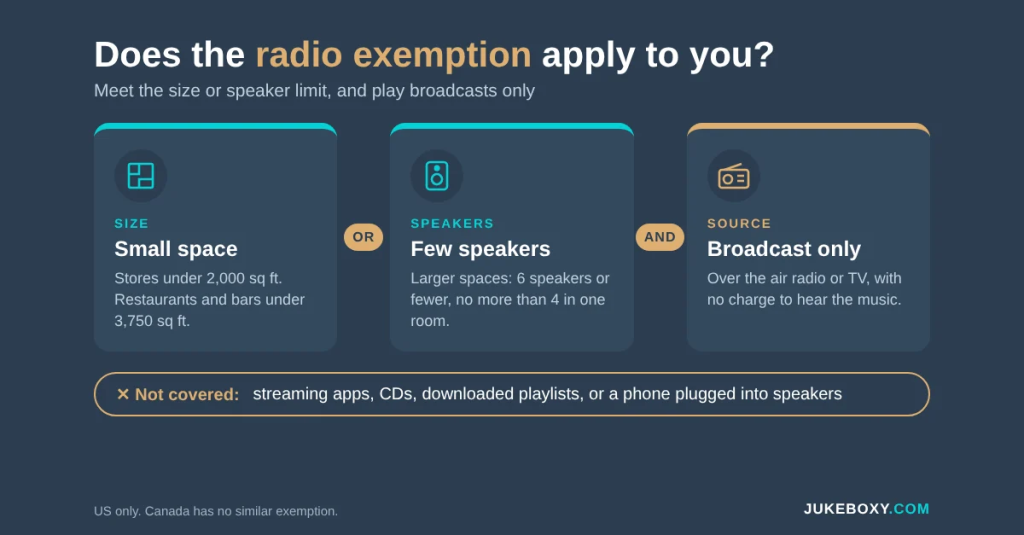
The exemption doesn’t cover streaming apps, CDs, downloaded playlists, or a phone plugged into your speakers. You also can’t control what plays on the radio, including ads for the store down the street.
In Canada
Canada uses a similar system with different names. Businesses that play background music usually need two licences:
- SOCAN covers songwriters and publishers (Tariff 15.A for background music).
- Re:Sound covers performers and record labels (Tariff 3.B for background music in businesses).
Since 2019, both licences are available through Entandem, a joint venture of SOCAN and Re:Sound, so you can handle them in one place. Some background music suppliers pay Re:Sound royalties on behalf of their subscribers, so ask your provider exactly what is covered.
Canada has no square footage exemption like the US one. If customers or guests can hear the music, plan on licensing it.
Copyright terms also differ. Canada counts the term from the songwriter’s death, while the US often counts from the year a song was published. A carol can be free in one country and still protected in the other. If you run locations on both sides of the border, use one service licensed in both. See our overview of licensing in the USA and Canada.
Three Holiday Music Myths That Cost Businesses Money
Myth 1: “Christmas songs are old, so they’re public domain.” Some carols are. As of January 1, 2026, compositions published in the US in 1930 or earlier are in the public domain. That includes classics like “Jingle Bells,” “Silent Night,” “Joy to the World,” and “Deck the Halls.”
Most of the songs your customers expect are much newer. “Winter Wonderland” and “Santa Claus Is Comin’ to Town” (both 1934) stay protected in the US until 2030. “White Christmas” (1942), “Rudolph the Red Nosed Reindeer” (1949), and “All I Want for Christmas Is You” (1994) are protected for decades more.
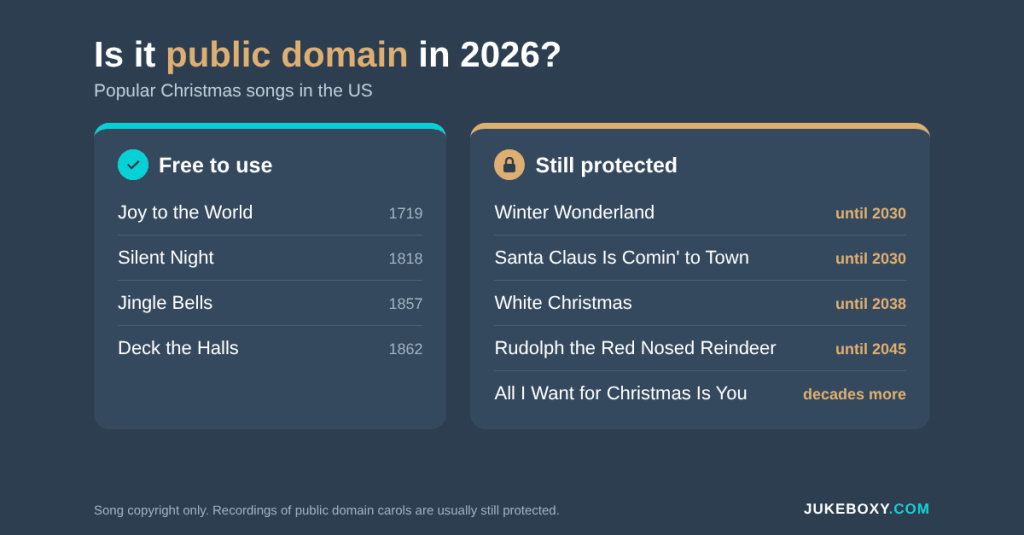
Myth 2: “If the song is public domain, any recording is free.” The recording has its own copyright. A 2019 recording of “Silent Night” is protected even though the 1818 carol isn’t. New arrangements of old carols can be protected too.
Myth 3: “Nobody checks.” PROs actively contact businesses, and the holiday season is when music is most noticeable. Licensing agents visit stores, restaurants, and bars, and letters often follow. It’s cheaper to plan ahead than to negotiate after a notice arrives.
Christmas Music Licensing FAQ
Do I need a license to play Christmas music in my store?
Yes, in most cases. Unless you only play radio or TV broadcasts and meet the Section 110(5)(B) limits, you need public performance licenses for the songs and a music source cleared for business use.
Is Christmas music copyright free?
No. Only compositions published in 1930 or earlier are public domain in the US as of 2026, and modern recordings of those carols are still protected.
Can I use Spotify or Apple Music for holiday music in my business?
No. Personal streaming accounts are licensed for personal use only. Use a commercial music service instead.
What licenses do Canadian businesses need for holiday music?
Usually a SOCAN licence for the songs and a Re:Sound licence for the recordings. Both are available through Entandem.
What happens if I play unlicensed Christmas music?
In the US, a court can award $750 to $30,000 per song, and up to $150,000 per song for willful infringement. Most cases start with a letter from a PRO asking you to buy a license
Does a business music service include Christmas songs?
A licensed service like Jukeboxy includes holiday playlists cleared for commercial use, so you don’t have to check the rights on each song yourself.
The Simple Way to Play Christmas Music Legally
You don’t need to track four US PROs, two Canadian collectives, and the copyright date of every song. A licensed background music service built for commercial use handles the music side for you.
Here is what to look for:
- Commercial licensing for every track. Every song in the holiday catalog should be cleared for business use, in the US and in Canada.
- Holiday playlists ready to go. Look for options by mood, such as classic, modern pop, jazzy, or instrumental, so you can match your brand.
- Scheduling. Start holiday music on a date you choose, blend it with your regular mix, and switch it off automatically after the season.
- Control across locations. Set one holiday schedule for every store from a single dashboard.
- Sonos and speaker support. Play through the system you already have.
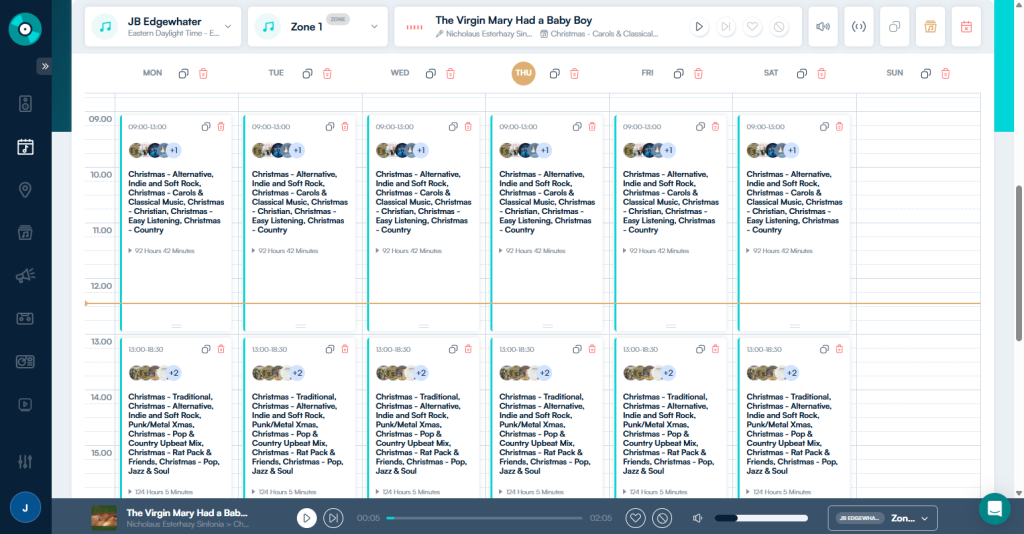
Jukeboxy has offered licensed music for business since 2013. Our holiday playlists work for retail stores, restaurants, hotels, and more. You can see Jukeboxy pricing and set up your holiday schedule in minutes.
A quick tip on timing: shoppers enjoy holiday music, but your staff hears it all day. Start with a light mix in mid November, then raise the share of holiday songs as December gets closer. Here is how to keep holiday music from wearing on your staff, plus some holiday playlist ideas to get started.
Your customers should notice your holiday soundtrack, never a licensing problem. Get your Christmas music licensed and scheduled now, and it will run itself all season while you focus on the rush.
Ready to plan your holiday soundtrack? Book a free consultation with the Jukeboxy team and get your playlists set before the busy season starts.
