


In 2026, a brand’s identity is no longer defined solely by what customers see, but by what they hear. As businesses scale, the challenge isn’t just growth—it’s maintaining a cohesive sensory experience. For multi-location enterprises, sonic branding has emerged as the invisible thread that ties a global or national presence together. While visual standards are often strictly enforced, the auditory environment is frequently left to chance, creating a “brand gap” that can alienate customers and dilute loyalty.
To win in today’s market, music must be treated as a core asset. Mastering your sound across every location is no longer a luxury; it is a strategic necessity for building trust and ensuring operational excellence.
1. Bridging the Brand Recognition Gap
Every brand has a unique frequency. In 2026, music translates your brand’s personality into an immediate emotional response. When a customer moves from a location in New York to one in California, the “Auditory DNA” should remain identical. Consistent sonic branding ensures that familiarity is built into every visit, turning a one-time customer into a brand loyalist through psychological comfort and trust.

2. The Hidden Risks of Decentralized Playlists
Relying on local managers or staff to curate music, often referred to as “aux cord anarchy”, is a liability for growing enterprises.
- Brand Dilution: Personal tastes rarely align with corporate identity.
- Operational Risk: Inconsistent volume levels and “dead air” disrupt the customer journey.
- Content Safety: Unfiltered lyrics can lead to immediate brand damage in family-oriented environments.
3. Centralized Management: Scaling with Precision
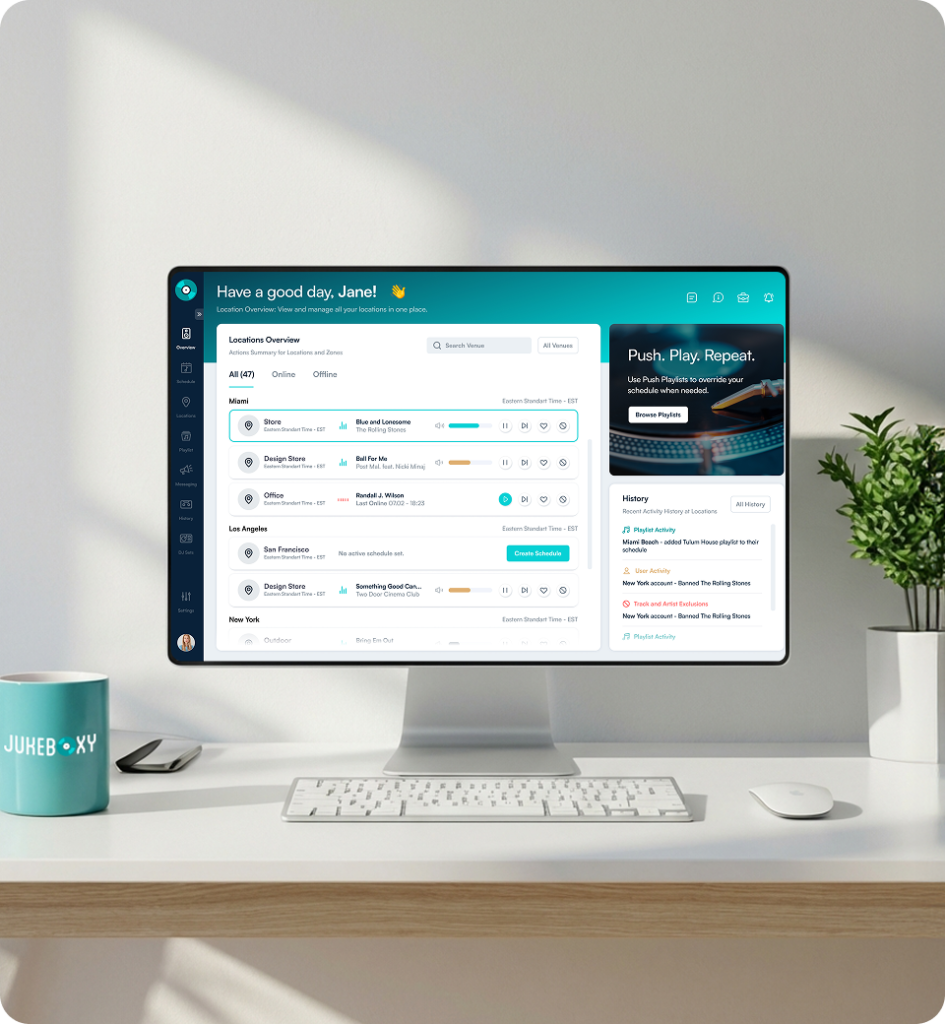
Centralized music management allows corporate teams to define the “Global Sound” while automating day-to-day operations. This software-driven approach enables:
- Automated Dayparting: Transitioning energy levels from morning focus to evening rush without manual intervention.
- Instant Updates: Deploying seasonal playlists or promotional messaging across 500+ sites with one click.
- Acoustic Control: Ensuring uniform volume and high-fidelity sound across diverse architectural spaces.
Stop the aux-cord anarchy. See how centralized management can save your team 10+ hours a week. Learn More.
4. Supporting Local Nuance Without Friction
Consistency doesn’t mean “one-size-fits-all.” The 2026 standard is Localized Alignment. Advanced platforms allow brands to maintain a core sound while subtly shifting genres to reflect local demographics or regional culture. This creates a “polished, not generic” feel that respects the local community while protecting the national brand.
5. Compliance and Commercial Licensing at Scale
As businesses grow, so does the complexity of music law. Using consumer streaming services in a commercial setting is a significant legal risk. Centralized platforms handle all licensing (ASCAP, BMI, SESAC, GMR) globally, providing a “firewall” against copyright infringement and ensuring that artists are compensated fairly.
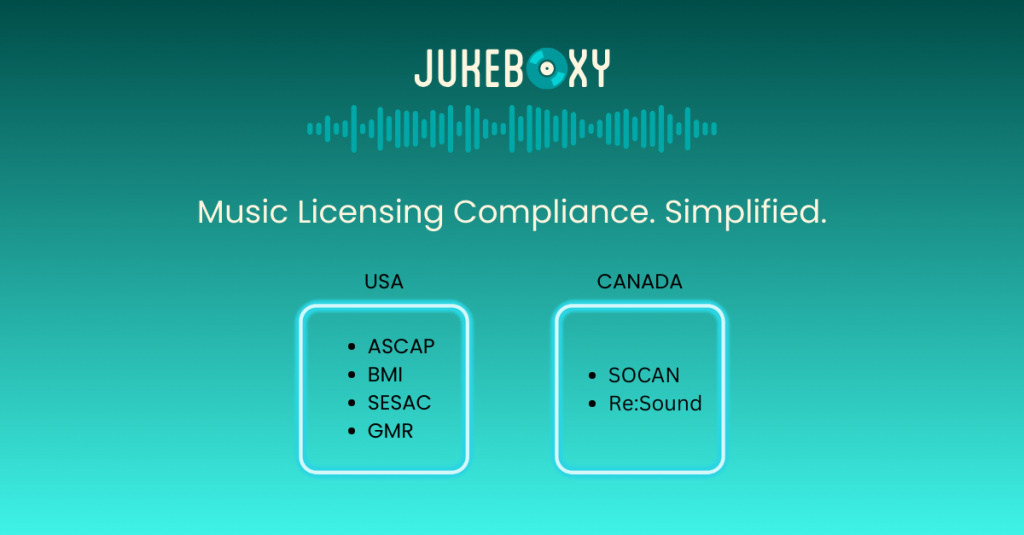
North American Licensing Coverage
A Note on Licensing & Compliance While the landscape of performance rights can be complex, Jukeboxy provides a comprehensive umbrella of protection for businesses operating within the United States and Canada. Our platform includes the necessary public performance licensing for ASCAP, BMI, SESAC, and GMR in the USA, as well as SOCAN and Re:Sound in Canada. For a deeper look at how these organizations calculate their rates, see our comprehensive guide on understanding music license fees.
Disclaimer: Licensing coverage is specific to the territories of the USA and Canada. Business owners are encouraged to consult with their Jukeboxy representative to ensure their specific commercial use case—such as live music or jukebox-style interaction—is fully covered under their chosen plan.
The Scalable Sound: Final Thoughts
In 2026, music is a scalable brand asset. By leveraging platforms like Jukeboxy, multi-location businesses can launch new sites with the confidence that the audio experience is already optimized, compliant, and perfectly aligned with the brand mission. When sound is treated as a core pillar of the business, scaling becomes a seamless transition rather than a compromise in quality.
Ready to unify your brand’s sound? Schedule a free sonic branding consultation for your business today. Get Started with Jukeboxy
Frequently Asked Questions
- How does centralized music management improve operations for multi-location brands?
Centralized management removes the “aux-cord anarchy” of having local staff choose the music. It allows corporate teams to set a “Master Brand Sound” and automate it across all locations via a single dashboard. Features like automated dayparting ensure the energy levels match the time of day (e.g., upbeat for the lunch rush, mellow for the morning) without any manual effort from on-site employees. - Can I legally use Spotify or Apple Music for my multi-location business?
No. Consumer streaming services are strictly for personal, non-commercial use. Playing these in a public business setting constitutes “public performance” and requires specific commercial licenses. Using personal accounts can result in significant copyright infringement fines, which often reach thousands of dollars per song. To remain compliant, multi-location businesses should use a dedicated commercial platform like Jukeboxy that handles ASCAP, BMI, SESAC, and GMR licensing centrally. - Does “consistent” music mean every location has to play the exact same songs?
Not necessarily. Consistency is about Brand Alignment, not identical loops. Modern systems allow you to maintain a core “sonic identity” while providing “localized nuance.” For example, a location in a high-traffic urban area might have a slightly higher tempo or genre variation compared to a quiet suburban branch, yet both remain clearly recognizable as the same brand. - What is “Sonic Branding,” and why is it important in 2026?
Sonic branding is the strategic use of sound and music to build a distinct brand identity, much like a visual logo. In 2026, where consumer attention is fragmented, sound acts as a powerful cognitive anchor. It triggers brand recall and emotional connection faster than visuals alone. For multi-location businesses, it ensures that the “vibe” of the brand remains intact, creating a sense of familiarity and trust regardless of which store a customer visits.
