

Your 7:45 crowd wants their latte fast. Your 2:30 crowd wants a quiet table for an hour. If one playlist runs all day, it is working against at least one of them.
Planning coffee shop music by time of day is one of the cheapest ways to improve how your café feels and performs. You already adjust staffing, menus, and lighting across the day. Your music deserves the same attention. Here is how to match your soundtrack to each daypart, from the morning rush to the afternoon lull.
Why Coffee Shop Music by Time of Day Matters
Music tempo shapes how fast people move, how long they stay, and how they judge your coffee. That makes it a business tool, not just background noise.
A 2025 study in the Journal of Sensory Studies tested this inside a working café with 400 customers. Researchers Yeoh and Spence compared upbeat music (above 120 BPM) with relaxed music (under 80 BPM). Here is what they found:
- Weekday guests who heard slow music gave the highest coffee quality ratings, about 18% higher than guests on the weekend, whether those weekend guests heard slow or fast music.
- Those same guests were more likely to say they would buy again.
- On weekends, about 65% of guests in the slow music group stayed over two hours, compared with about 15% in the fast music group.

The lesson is simple. Tempo changes behavior. So the right tempo depends on what you need from each hour of the day. We see the same effect in dining rooms, as covered in how music impacts taste and dining perception.
Your Coffee Shop Music Schedule at a Glance
| Daypart | Your goal | Tempo | Volume | Styles that fit |
|---|---|---|---|---|
| Opening (6 to 7 am) | Calm, welcoming start | 70 to 90 BPM | Low | Acoustic, soft soul, light jazz |
| Morning rush (7 to 10 am) | Move the line, lift energy | 100 to 120 BPM | Medium | Upbeat indie, pop, funk, Motown |
| Late morning (10 am to noon) | Settle in, encourage a second order | 85 to 100 BPM | Medium low | Indie folk, mellow pop |
| Lunch (noon to 2 pm) | Steady turnover | 95 to 110 BPM | Medium | Neo soul, light pop, Latin grooves |
| Afternoon lull (2 to 5 pm) | Longer stays, add-on sales | 60 to 85 BPM | Low | Lo-fi, bossa nova, jazz, chill acoustic |
| Evening (5 pm to close) | Wind down, social feel | 80 to 100 BPM | Low to medium | Soul, chill electronic, classic covers |
Treat these numbers as a starting point. Your neighborhood, menu, and brand should shape the final mix.
The Morning Rush: Music That Keeps the Line Moving
During the morning rush, play upbeat music between 100 and 120 BPM to keep energy high and the line moving. Your guests are on a schedule. Your baristas are too.
Faster music gives the room a sense of momentum. It also masks the hiss of the steam wand and the clatter at the bar, so the space feels busy in a good way instead of stressful.

Tips for the rush:
- Choose familiar, positive songs. Morning is not the time for a challenging deep cut.
- Keep the volume clear but not loud. Orders still need to be heard at the register.
- Avoid heavy bass. It travels poorly in small rooms with hard surfaces.
- Use the first 30 minutes after opening as a softer warm up before the crowd arrives.
Late Morning and Lunch: The Middle Gear
From late morning through lunch, ease the tempo down to 85 to 110 BPM to balance turnover with comfort. This is when guests start to sit, work, and meet.
Late morning is a good window for a second purchase. A relaxed but bright playlist makes it easy to stay for a pastry or a refill. At lunch, nudge the energy back up a little if you also serve food and need tables to turn.
This middle stretch is also a good time for in-store audio messages. A short message between songs about your seasonal drink or lunch combo can lift add-on sales without any staff effort.
The Afternoon Lull: Music That Invites People to Stay
In the afternoon lull, switch to slow music under 85 BPM to create a calm room where guests stay longer and order more. This is where the research above matters most.
Slow tempo signals that there is no rush. Remote workers, students, and friends catching up will settle in. Longer stays during quiet hours mean more refills, snacks, and a fuller room that draws in people walking by.

Good fits for the lull:
- Lo-fi and chill beats for laptop crowds
- Bossa nova and soft jazz for a warm, classic café feel
- Acoustic covers of well-known songs for broad appeal
- Instrumental tracks so lyrics do not compete with conversation or focus
Watch the volume here. If guests are leaning in to hear each other, it is too loud.
Weekends and Common Mistakes to Avoid
Weekends need their own schedule. The study above found weekend guests strongly preferred slow music, so keep tempos lower on Saturday and Sunday, even in the morning.
Here are the mistakes we see most often in cafés:
- One playlist all day. The rush and the lull want opposite things. One mix cannot serve both.
- Staff phones on shuffle. It is a licensing risk, covered in the next section.
- Volume set once and forgotten. A level that works in a full room feels loud in an empty one. Lower it as the crowd thins.
- Too much repetition. Your regulars come daily. Your baristas are there all shift. A short playlist on repeat wears on both. A large, refreshed library keeps things fresh.
- Explicit lyrics. Families, students, and business meetings all share your space. Stick to clean versions.
Fixing even one of these can change how your shop feels by this afternoon.
Why Staff Phones on Shuffle Put Your Café at Risk
Letting a barista plug in their phone feels harmless. It is one of the most common licensing gaps we see in coffee shops, and it can cost far more than a proper music service.
Personal streaming apps are licensed for personal use only. Their terms do not cover playing music for customers in a business. That public performance needs separate licenses from the organizations that represent songwriters and artists, such as ASCAP, BMI, SESAC, and GMR in the USA.
These organizations do enforce their rights. A business caught playing unlicensed music can owe back fees, and under US copyright law, statutory damages range from $750 to $150,000 per song.
There is a brand cost too:
- One person’s taste takes over. Your café sounds like whoever is on shift, not like your brand.
- The mood changes every shift. Monday morning sounds nothing like Tuesday morning.
- Explicit lyrics slip in. Personal playlists rarely stick to clean versions.
- No daypart plan. Shuffle ignores the tempo strategy that keeps the rush moving and the lull relaxed.
How to Automate Your Coffee Shop Music Schedule
The best schedule is one your team never has to think about. Manual switching gets forgotten the moment the shop gets busy.
With Jukeboxy for coffee shops, you can:
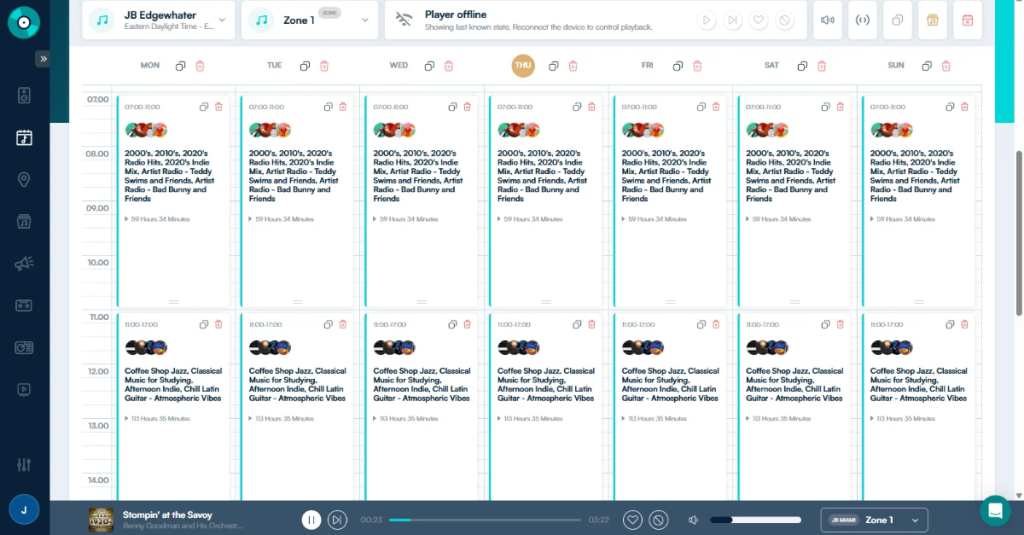
- Schedule playlists by day and hour. Set your rush, lull, and evening playlists once and let them run all week.
- Use curated café playlists. Choose ready-made options like “Coffee Shop Slow Tempo” or “High Tempo Indie Dance.”
- Exclude genres. Remove styles that do not fit your brand.
- Control music remotely. Adjust the mood from your phone, even when you are off site.
- Manage every location from one dashboard. Keep the same daypart strategy across all your cafés. Learn more in our guide to multi-location sonic branding.
Every track is fully licensed for business use, covering ASCAP, BMI, SESAC, GMR, and SoundExchange in the USA, plus SOCAN and Re:Sound in Canada. That matters because personal apps like Spotify are not licensed for commercial play. Read more in Can I use Spotify, Apple and others for my business? and our business music licensing guide.
Your coffee shop changes from hour to hour, and your music should follow. Upbeat music keeps the morning rush moving, and slower music turns the afternoon lull into longer stays and extra orders. A simple schedule, set once, does the work every day.
Ready to build your daypart soundtrack? Start your 14-day free trial of Jukeboxy for coffee shops and have your first schedule running today.
Frequently Asked Questions
What is the best music for a coffee shop?
The best coffee shop music changes with the time of day. Use upbeat indie or pop at 100 to 120 BPM during the morning rush, and slower acoustic, jazz, or lo-fi under 85 BPM in the afternoon.
What tempo should coffee shop music be?
Aim for 100 to 120 BPM during busy hours and 60 to 85 BPM during quiet hours. In a 2025 café study, weekday guests who heard slow music rated their coffee about 18% higher than guests on the weekend, whether those weekend guests heard slow or fast music.
Does music make customers stay longer in a café?
Yes. In a 2025 café study published in the Journal of Sensory Studies, about 65% of weekend guests who heard slow music stayed over two hours, compared with about 15% of those who heard fast music.
How loud should music be in a coffee shop?
Loud enough to fill silence, quiet enough for easy conversation and order taking. Lower the volume as the room empties.
Can I play Spotify in my coffee shop?
No. Personal streaming apps are licensed for personal use only. A commercial service like Jukeboxy covers ASCAP, BMI, SESAC, GMR, and SoundExchange in the USA, and SOCAN and Re:Sound in Canada.
How do I change coffee shop music automatically during the day?
Use a business music service with scheduling. Jukeboxy lets you set playlists by day and hour, so your rush and lull playlists switch on their own.
