


Quick Answer: Is AI Music Legal for Your Business?
Yes, AI-generated music can be legal to play in a store, restaurant, hotel, or other business, but it is not automatically copyright-free or cleared for commercial use. In the United States, music created entirely by AI without sufficient human authorship generally does not qualify for copyright protection. However, AI-assisted songs may contain copyrighted material, and commercial-use restrictions can still apply.
Before playing AI-generated music in your business, verify the source, the provider’s commercial-use terms, and whether public performance licensing is required.
AI-generated music is increasingly marketed as an affordable, royalty-free alternative to traditional background music. For restaurants, retail stores, hotels, and other businesses, the promise of lower costs and fewer licensing requirements can be appealing.
But there’s an important distinction between music that is generated by AI, music that is free from copyright protection, and music that is legally cleared for commercial use.
In 2025 and 2026, developments involving the U.S. Copyright Office, Performing Rights Organizations (PROs), and lawsuits against AI music companies brought these questions into sharper focus.
Here’s what business owners need to know about AI music copyright, public performance licensing, and the potential risks of using AI-generated music in commercial spaces.
This article provides general information about music licensing and copyright, not legal advice. For guidance specific to your business, consult a qualified attorney.
What Changed for AI Music in 2025 and 2026
Several decisions reshaped the rules in a short time:
- Human authorship is required for copyright. The U.S. Copyright Office said in its January 2025 report that music generated entirely by AI from prompts alone can’t be copyrighted. In March 2026, the U.S. Supreme Court declined to hear Thaler v. Perlmutter, leaving that human authorship rule in place.
- The PROs drew a line. In October 2025, ASCAP, BMI and SOCAN agreed to register songs made partially with AI tools, as long as a human contributed. Songs created entirely by AI are not eligible.
- Major labels moved from lawsuits to licensing. Warner Music Group and Universal Music Group settled with the AI platform Udio in late 2025, and Warner also settled with Suno. Other cases are still in court.
- Courts outside the USA addressed AI music infringement. In July 2026, a Munich court ruled largely in favor of German music rights organization GEMA in its copyright infringement case against Suno. The case involved protected musical compositions used in AI training and reproduced in generated outputs. The ruling, which remains subject to appeal, highlights the legal risks associated with unauthorized use of copyrighted music in AI systems.
These developments point toward greater emphasis on human creativity, copyright protection, and licensing agreements between AI companies and music rights holders. However, important legal questions surrounding AI-generated music remain unresolved.
Is AI Music Legal to Play in a Store, Restaurant or Hotel?
Playing music for customers counts as a “public performance” under copyright law. That’s why businesses need PRO licenses, even when they already pay for a streaming account.
So where does AI music fit? It depends on what is actually in your playlist.
Fully AI-Generated Tracks
Music generated entirely by artificial intelligence without sufficient human creative involvement generally does not qualify for copyright protection under current U.S. Copyright Office guidance.
However, that does not automatically mean every AI-generated track is free to use commercially. Businesses must still review the AI platform’s terms of service and confirm that the music does not reproduce protected elements of existing songs.
Another challenge is transparency. Without reliable information about how a track was created, whether humans contributed to it, and what material it contains, businesses may have difficulty determining which rights and permissions apply.
Songs Written Partly with AI
Songs created with AI assistance may qualify for copyright protection when they contain sufficient original human authorship. ASCAP, BMI, and SOCAN accept qualifying partially AI-generated compositions into their repertoires. Businesses publicly performing copyrighted music must have the appropriate licensing coverage, whether the music was created with AI assistance or entirely by human musicians.
Mixed AI playlists
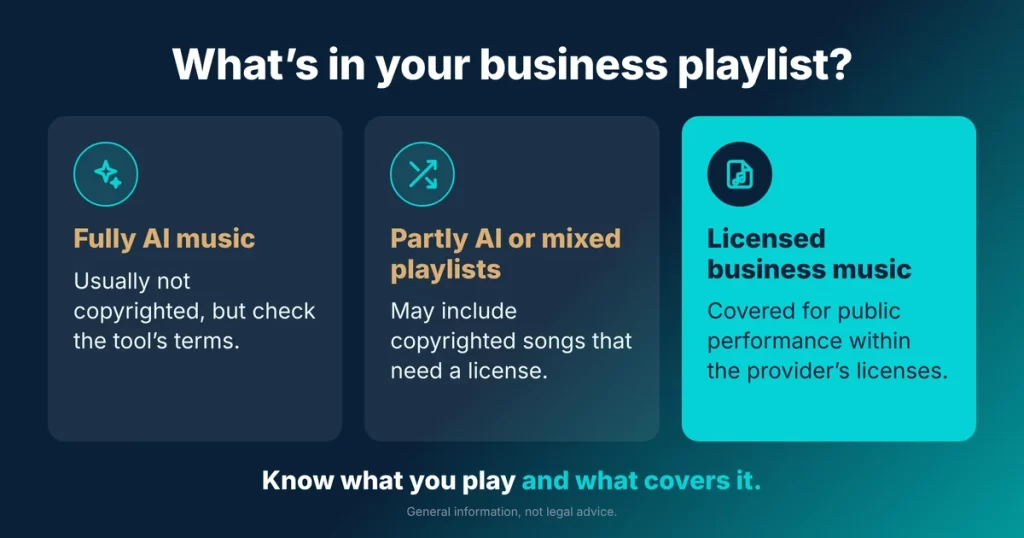
Some AI music streams and playlists combine fully AI-generated tracks with human-written or AI-assisted compositions.
If a playlist includes copyrighted songs, businesses generally need appropriate public performance licensing for those works, unless another valid authorization or exemption applies.
This makes it important to verify what is actually included in an AI music playlist rather than assuming that every track is copyright-free or royalty-free.
| Music source | Copyright status | Public performance license needed? | What to verify |
|---|---|---|---|
| Fully AI generated track | Generally not protected without sufficient human authorship | Often not for that track, but hard to confirm | Generator terms, track origins and similarity to protected songs |
| Song written partly with AI | May be protected if human authorship is sufficient | Yes, when the work is copyrighted | Which PRO repertoire includes it |
| Mixed AI playlist or “royalty free” stream | Varies track by track | Often yes | What each track is and which licenses cover it |
| Personal streaming account | Protected | Yes, and personal plans don’t allow business use | Business-use terms and PRO coverage |
| Licensed business music service | Protected and licensed | Covered within the provider’s licensed repertoire, territory and permitted uses | Which PROs, territories and uses are included (e.g. live music, DJs, events) |
The Hidden Risks of AI Music for Business Owners
Even when an AI track is technically license free, other problems can land on your counter:
- Lookalike songs. AI models trained on real recordings can produce melodies or lyrics close to protected songs. The Munich court found that Suno reproduced protected songs without a license.
- Terms of service. Many AI music generators limit commercial use to paid plans, and their terms change often. A track from a free account playing in your dining room may break those terms.
- No proof of coverage. If a PRO representative contacts you, you need to show what covers your music. A vague “royalty free” promise is weak proof.
- Open lawsuits. Some AI tools are still in court over how they were built.
- Costly penalties. Copyright infringement can lead to statutory damages for each work infringed, plus legal fees, and a single playlist can hold hundreds of songs. Actual liability depends on the circumstances and the court’s findings.
There’s also a volume problem. The growth of AI-generated music is accelerating. In July 2026, Deezer reported receiving nearly 90,000 fully AI-generated tracks a day, with AI music making up more than 50% of daily uploads on peak days in June. The platform also reported that up to 85% of streams on fully AI-generated tracks in 2025 were fraudulent, even though AI music made up only 1–3% of total streams. These figures are specific to Deezer and do not represent the entire music streaming industry.
Does AI Music Hurt the Customer Experience?

A 2025 study conducted by Ipsos for Deezer found that 97% of participants could not consistently distinguish between AI-generated and human-created music in a blind test featuring two AI-generated songs and one human-created song.
But recognizing whether a song was created by AI is different from connecting with the music itself. For businesses, the question goes beyond whether customers can identify AI-generated tracks. It is also about whether the music creates the atmosphere, recognition, and emotional connection the brand wants to achieve.
Have you ever noticed customers holding their phones up toward your restaurant’s speakers? Chances are, they’re using Shazam to identify a song they enjoy. It’s a great example of how music can create a lasting connection between customers and your business.
When customers discover a song they love at your establishment, they can add it to their personal playlists and listen to it again long after their visit. And every time that song plays, it might bring back memories of where they first heard it: your restaurant, store, or hotel.
With AI-generated background music that isn’t commercially released or available on streaming platforms, that opportunity may be lost. Customers might not be able to identify the song, find it again, or add it to their personal music collections.
Research suggests that background music can influence customer mood, perceptions of the environment, and purchasing behavior. The right music selection can support a business’s atmosphere and customer experience.
Professionally curated playlists help businesses create a consistent musical identity rather than relying on an endless rotation of generic background tracks.
While AI-generated music can provide an affordable source of background audio, it may not offer the same opportunities for familiarity, music discovery, and emotional connection as songs from established and emerging artists.
For businesses, music selection should be intentional. A restaurant may need a different atmosphere during lunch and dinner, while a retail store may adjust its music throughout the day to reflect customer traffic, shopping patterns, and brand identity.
This is where professional music curation makes a difference. With services like Jukeboxy, businesses can access expertly curated playlists designed for different environments, customer demographics, and times of day. Whether selecting music for restaurants or music for retail stores, the goal is to create a consistent, engaging atmosphere supported by properly licensed background music.
Ultimately, choosing music for a business should involve more than comparing subscription costs or how cheaply tracks can be produced. Music quality, brand alignment, customer experience, and licensing should all be part of the decision.
How to Check If Your Business Music Is Legal in 2026
Use this quick check for every location:
- List every music source. Include streaming apps, AI tools, radio, TV, hold music and anything staff plug in.
- Ask each provider which licenses they hold. In the USA, look for ASCAP, BMI, SESAC and GMR. In Canada, look for SOCAN and Re:Sound.
- Get licensing confirmation in writing. Request documentation explaining the provider’s licensing coverage, permitted business uses, applicable territories, and any exclusions. For AI-generated music, confirm whether the service grants commercial playback rights and how potential third-party copyright claims are addressed.
- Check whether commercial use includes public playback. Permission to download, monetize, or distribute AI-generated music does not automatically establish that every copyright and licensing issue associated with playing it in a business has been resolved.
For example, AI music platform Suno grants commercial-use rights to songs created under qualifying paid subscriptions but explicitly states that these rights do not guarantee copyright protection. Businesses should verify whether their intended use, including public playback in commercial establishments, is permitted under the provider’s terms. - Read the terms for any AI tool. Confirm your plan allows commercial use and check who is responsible if a track infringes.
- Lock down playback. Stop staff from switching to personal phones or accounts during service.
- Review once a year. Licenses, terms and laws are changing fast, so recheck your setup annually.
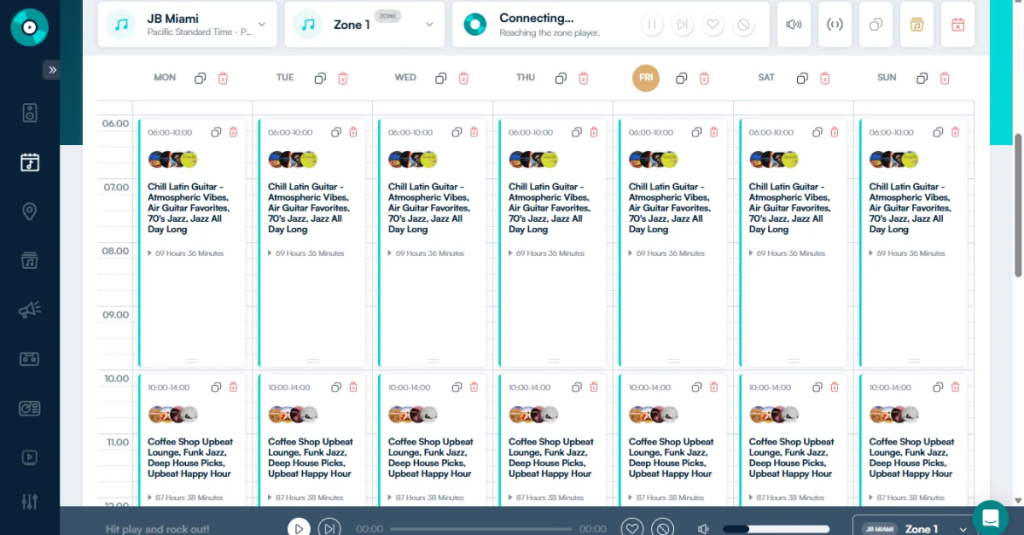
For step 6, a central system helps. With Jukeboxy’s built in scheduling and dashboard, you set playlists for every daypart and location, which makes it easier to keep staff from swapping in unlicensed music. If you play through Sonos, our Sonos for Business setup works the same way, though anyone with access to your Sonos system could still switch to another music service, so set clear rules for staff.
Is AI Music Legal FAQ
Is AI music legal for businesses to play?
It is not illegal to play AI music in a business. The risk comes from tracks that are not fully AI, songs that resemble protected works, and AI tools whose terms limit commercial use. Music covered by the appropriate public performance licenses significantly reduces that risk.
Is AI generated music copyright free?
Music created entirely by AI from prompts alone generally can’t be copyrighted in the USA. Songs where a human made meaningful creative contributions can be protected. “Copyright free” claims also don’t protect you if an AI track copies parts of an existing song.
Do I need an ASCAP or BMI license to play AI music?
Not necessarily. In the United States, music created entirely by AI without sufficient human authorship generally does not qualify for copyright protection, so public performance licensing for the underlying composition may not be required.
However, AI-assisted songs containing copyrightable human contributions can be registered with Performing Rights Organizations such as ASCAP and BMI. Businesses playing those compositions publicly generally need appropriate licensing coverage.
The important factor is the copyright status and permitted use of the music, not simply whether AI was involved in creating it.
If you’re unsure whether your AI-generated music requires licensing, consult the relevant Performing Rights Organizations (PROs) or a qualified copyright attorney before using it in your business.
Can I play Suno or Udio songs in my store?
It depends on your plan and the platform’s current terms, which keep changing as these companies settle lawsuits and launch licensed models. Get written confirmation that commercial use and public playback are allowed. Also check who is responsible if a track turns out to infringe.
What happens if my business plays unlicensed music?
PROs can contact you, ask you to buy a license and, in some cases, sue for copyright infringement. Damages can be assessed for each work infringed, and legal fees can add even more. Actual liability depends on the circumstances and the court’s findings.
Does Jukeboxy include music licensing?
Yes. Jukeboxy plans include public performance licenses from ASCAP, BMI, SESAC and GMR in the USA, plus SOCAN and Re:Sound in Canada. You also get 500+ curated playlists built for restaurants, retail and hospitality. This coverage applies to the background music played through Jukeboxy, not to other uses such as live performances, DJs or certain special events.
Will AI music laws change again?
Very likely. Lawsuits against AI music companies are still active, and copyright offices keep reviewing their AI rules. Working with a fully licensed provider significantly reduces your public performance risk, though it may not resolve every copyright question involving AI-generated material.
Is Royalty-Free AI Music the Same as Copyright-Free Music?
No. Royalty-free music and copyright-free music are not the same.
Royalty-free generally means music can be used under specific licensing terms without paying recurring royalties for each permitted use. It does not necessarily mean the music is free of copyright restrictions.
Copyright-free music generally refers to music that is not protected by copyright, although the term is sometimes used loosely in marketing.
Businesses should always review the actual licensing terms before assuming that royalty-free or AI-generated music can be played publicly without additional permissions.
Play Music Your Business Can Stand Behind
AI-generated music is changing the music industry, but lower production costs do not automatically mean fewer licensing responsibilities or a better customer experience.
For businesses, the real value of background music comes from choosing the right songs, creating the right atmosphere, and knowing that the music is properly licensed for commercial playback.
Jukeboxy combines commercially licensed music with expertly curated playlists, automated scheduling, and centralized music management for businesses across the United States and Canada.
Ready to simplify your business music? Start your free 14 day Jukeboxy trial with no credit card required, or book a consultation to explore the best music solution for your business.
